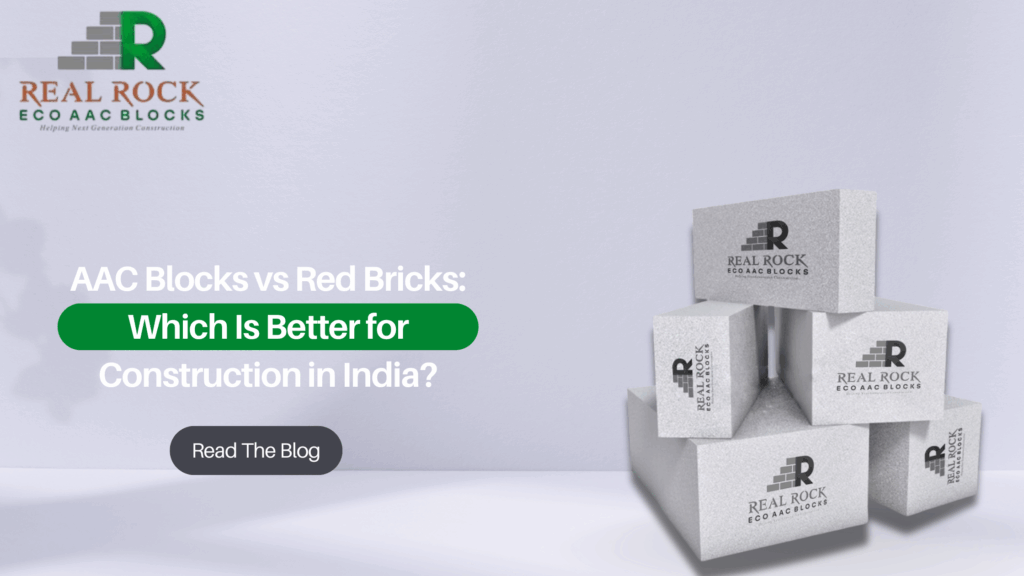
Choosing between AAC blocks vs red bricks is one of the most important decisions in construction. It directly affects your building’s strength, cost, durability, and even long-term maintenance.
For decades, red bricks dominated Indian construction. But today, AAC blocks are quickly becoming the preferred choice for modern buildings.
So, which one is actually better?
Let’s break it down in a simple, no-nonsense way so you can make the right decision.
What Are AAC Blocks?
AAC (Autoclaved Aerated Concrete) blocks are lightweight construction materials made from cement, lime, fly ash, water, and aluminum powder.
They are manufactured using a high-pressure curing process, which creates tiny air pockets inside the blocks. This gives them excellent insulation and reduces weight significantly.
What Are Red Bricks?
Red bricks are traditional building materials made from clay, molded and baked in kilns.
They’ve been used for centuries and are still common across India, especially in smaller towns and rural areas.
But here’s the catch, just because something is old doesn’t mean it’s still the best.
AAC Blocks vs Red Bricks: Key Differences
Let’s compare both side by side.
1. Weight
AAC Blocks:
Lightweight, about 3 times lighter than red bricks
Red Bricks:
Heavy and increase structural load
👉 Lighter materials = lower foundation cost + better for high-rise buildings
2. Strength and Durability
AAC Blocks:
High compressive strength, uniform quality
Red Bricks:
Strength varies depending on soil quality and kiln process
👉 AAC blocks are more consistent and reliable
3. Construction Speed
AAC Blocks:
Larger size means fewer joints and faster work
Red Bricks:
Smaller size means more time, more labor
👉 Faster construction = reduced labor cost
4. Thermal Insulation
AAC Blocks:
Excellent insulation, keeps interiors cool
Red Bricks:
Poor insulation, absorbs heat
👉 In Indian summers, AAC blocks are a game changer
5. Cost Comparison
At first glance:
- Red bricks seem cheaper
- AAC blocks look slightly expensive
But here’s the real story:
AAC Blocks Save Money Through:
- Less cement usage
- Reduced steel requirement
- Lower labor cost
- Energy savings
👉 Overall project cost can reduce by 10 to 20 percent
6. Eco-Friendliness
AAC Blocks:
Made using fly ash, environmentally friendly
Red Bricks:
Made from clay, causes soil depletion and pollution
👉 AAC blocks clearly win for sustainable construction
7. Sound Insulation
AAC Blocks:
Better soundproofing due to porous structure
Red Bricks:
Average sound insulation
8. Water Absorption
AAC Blocks:
Lower water absorption
Red Bricks:
Higher water absorption, can lead to dampness
Quick Comparison Table
| Feature | AAC Blocks | Red Bricks |
|---|---|---|
| Weight | Lightweight | Heavy |
| Strength | Uniform & reliable | Varies |
| Speed | Fast construction | Slow |
| Insulation | Excellent | Poor |
| Cost Efficiency | High (long-term) | Low |
| Eco-Friendly | Yes | No |
Why Builders in India Are Switching to AAC Blocks
Construction trends are changing fast.
Builders today care about:
- Speed
- Cost efficiency
- Sustainability
- Long-term durability
AAC blocks tick all these boxes, while red bricks struggle to keep up.
This is why most modern residential and commercial projects are moving toward AAC blocks.
When Should You Use AAC Blocks?
AAC blocks are ideal for:
- High-rise buildings
- Residential homes
- Commercial spaces
- Offices and malls
- Industrial construction
Basically, if you’re building anything modern, AAC blocks make more sense.
When Are Red Bricks Still Used?
Red bricks are still used in:
- Small-scale construction
- Rural areas
- Budget-constrained projects
But even in these cases, AAC blocks are slowly replacing them.
Why Choose Real Rock AAC Blocks?
Not all AAC blocks deliver the same performance.
If you want consistent quality and long-term reliability, Real Rock AAC Blocks are a trusted choice for construction projects.
What Makes Real Rock AAC Blocks Stand Out?
- Precision manufacturing
- Uniform size and shape
- High strength and durability
- Reliable supply for large-scale projects
- Designed for modern Indian construction needs
Whether you’re a contractor, builder, or homeowner, choosing Real Rock AAC Blocks means building smarter, faster, and more efficiently.
FAQs (Optimized for Voice Search & Featured Snippets)
Which is better, AAC blocks or red bricks?
AAC blocks are better because they are lightweight, energy-efficient, and reduce overall construction costs.
Are AAC blocks cheaper than red bricks?
AAC blocks may seem expensive initially, but they reduce total construction costs through savings in cement, steel, and labor.
Do AAC blocks last longer than red bricks?
Yes, AAC blocks offer high durability and can last over 50 years with proper construction.
Are AAC blocks good for Indian climate?
Yes, AAC blocks provide excellent thermal insulation, making them ideal for hot Indian weather.
Final Verdict: AAC Blocks or Red Bricks?
Let’s keep it real.
Red bricks are traditional, but AAC blocks are practical.
If you’re building in today’s world and want:
- Faster construction
- Lower long-term costs
- Better insulation
- Strong and durable structures
Then AAC blocks are the clear winner.
And if you want quality you can rely on, Real Rock AAC Blocks give you the performance your project deserves.
Conclusion
Construction is evolving, and sticking to outdated materials can cost you more in the long run.
AAC blocks are not just an alternative, they are the future of construction in India.
So if you’re planning your next project, make the smarter choice from day one.