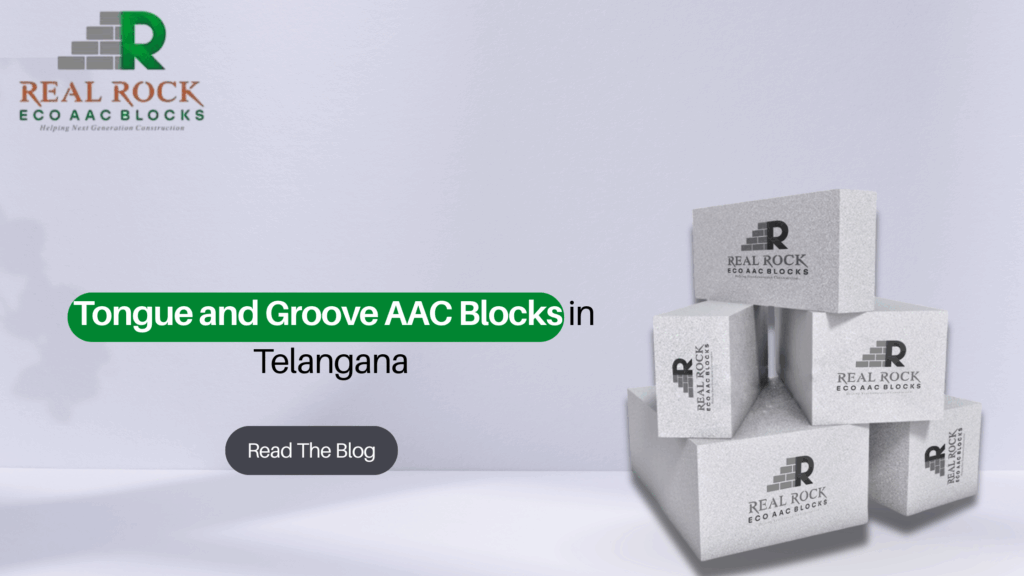
If you’ve been in the construction business or are planning to build your dream home, you’ve likely heard the buzz around AAC blocks. But there’s a specific innovation within this category that’s quietly revolutionising how India builds — Tongue and Groove AAC Blocks.
Unlike conventional flat-faced AAC blocks, Tongue and Groove (T&G) AAC blocks feature an interlocking profile on their edges — one side has a projecting “tongue” and the other has a recessed “groove.” When two blocks are placed together, they lock seamlessly, creating a bond that is stronger, faster to lay, and far more precise than traditional masonry.
Real Rock AAC — based in Miryalaguda, Telangana — has the distinction of being South India’s first manufacturer of Tongue and Groove AAC Blocks, making them a pioneering force in next-generation construction across Hyderabad, Andhra Pradesh, and Telangana.
In this blog, we’ll answer everything you need to know: What makes T&G AAC blocks special? Why are builders switching to them? And how do they compare to regular AAC blocks and traditional red bricks?
What Exactly Are Tongue and Groove AAC Blocks?
Tongue and Groove AAC Blocks are Autoclaved Aerated Concrete (AAC) blocks manufactured with a precision-cut interlocking joint profile. The “tongue” is a raised ridge running along one edge, while the “groove” is a matching channel on the opposite edge. When stacked or placed side by side, these profiles interlock — much like the way hardwood flooring or puzzle pieces fit together.
This design is not just aesthetic. It serves a fundamental structural and functional purpose:
- Vertical and horizontal alignment becomes effortless
- Mortar usage is drastically reduced (only thin-bed adhesive is needed at the horizontal joints; the vertical joints are interlocked without mortar)
- Fewer gaps and cold bridges mean better insulation performance
- Wall construction speed increases significantly
The blocks are made using the same proven AAC formula — fly ash, gypsum, lime, cement, and aluminum powder — cured under high temperature and pressure in an autoclave. The result is a lightweight, load-bearing, thermally efficient, and fire-resistant building block that now also offers superior jointing precision thanks to the T&G profile.
How Are Tongue and Groove AAC Blocks Different from Regular AAC Blocks?
| Feature | Regular AAC Blocks | Tongue & Groove AAC Blocks |
|---|---|---|
| Joint Type | Flat mortar joints | Interlocking T&G profile |
| Mortar Required | Standard mortar at all joints | Thin-bed adhesive only at horizontal joints |
| Alignment Accuracy | Requires skilled mason for precision | Self-aligning due to interlocking design |
| Construction Speed | Moderate | Significantly faster |
| Thermal Bridging | Some gaps possible | Minimal — tighter fit reduces bridging |
| Structural Integrity | Good | Better — interlocking increases cohesion |
| Wastage | Moderate (mortar + block trimming) | Lower due to precision sizing |
This comparison makes it clear: T&G AAC blocks are an upgrade in every measurable way over flat-faced AAC blocks — and they already start from a position of superiority over traditional red bricks.
What Are the Key Benefits of Tongue and Groove AAC Blocks?
1. Faster Construction = Lower Labour Costs
Time is money on any construction site. Because T&G blocks self-align during placement, masons spend significantly less time correcting alignment, re-checking levels, and waiting for mortar to set between courses. Studies and on-site observations consistently show that T&G AAC walling can be 30–40% faster than conventional brick masonry. For a builder running multiple projects simultaneously, this directly translates into labour savings and faster project handover.
2. Dramatically Reduced Mortar Consumption
Traditional red brick walls require thick mortar beds at every joint — horizontal and vertical. Regular AAC blocks still need mortar at the vertical joints. With Tongue and Groove AAC blocks, vertical joints are eliminated from mortar requirements entirely — the interlocking profile handles that connection. Only thin-bed adhesive mortar is applied at horizontal joints, and even that layer is far thinner than conventional mortar beds.
The result? Material cost savings of up to 25–30% on jointing mortar alone over the course of a full project.
3. Superior Thermal Insulation
One of the biggest advantages of AAC blocks in general is their cellular, porous structure that traps air and resists heat transfer. Tongue and Groove AAC blocks take this further: because the joints are tighter and there are fewer mortar-filled gaps (which conduct heat far more readily than AAC itself), the overall wall assembly achieves higher effective thermal resistance.
In cities like Hyderabad where summer temperatures routinely cross 40°C, this translates into measurably cooler interiors — reducing the load on air conditioning systems and lowering electricity bills for occupants by a significant margin year after year.
4. Excellent Soundproofing
The porous, aerated structure of AAC is a natural sound damper. T&G AAC blocks — with their tighter, more gap-free wall assembly — offer enhanced sound insulation compared to brick walls or even standard AAC block walls with mortar joints. This is particularly valuable for:
- Residential buildings near highways or busy roads
- Apartment complexes where inter-unit sound privacy matters
- Commercial buildings like offices, hospitals, and schools
5. Lightweight Yet Strong
AAC blocks are already approximately 50% lighter than conventional red clay bricks of equivalent size. This reduced dead load has a cascading positive effect on the entire structure:
- Smaller, lighter structural frames (columns and beams)
- Reduced foundation load — potentially smaller or shallower foundations
- Lower overall steel and cement consumption in the structural frame
- Reduced transportation costs to the construction site
Real Rock AAC Blocks achieve an average compressive strength of 3 to 5 N/mm², meeting and exceeding Indian building standards for load-bearing and partition wall applications.
6. Outstanding Fire Resistance
Tongue and Groove AAC blocks — like all AAC products — are inherently non-combustible. Real Rock AAC blocks are tested to withstand fire for up to six hours and temperatures up to 1,200°C. This makes them one of the most fire-safe walling materials available in the market today, offering occupants and insurers significant peace of mind.
7. Eco-Friendly and Sustainable
Modern construction cannot ignore its environmental footprint. Real Rock AAC blocks are manufactured using fly ash — an industrial by-product of thermal power plants — as a primary raw material. This diverts waste from landfills and reduces the consumption of virgin natural resources like clay and soil (which are depleted during brick manufacturing).
Furthermore, the precision of T&G jointing means less material waste on-site, and the lighter weight means fewer truck trips for delivery — reducing the project’s overall carbon footprint.
8. Pest and Moisture Resistant
AAC blocks consist entirely of inorganic materials, offering no nutritional value to termites or other pests. There is no wood, organic fibre, or biodegradable component within the block. Combined with appropriate surface waterproofing, T&G AAC walls provide excellent long-term resistance to moisture ingress — a critical advantage in the monsoon-heavy climates of Telangana and Andhra Pradesh.
Are Tongue and Groove AAC Blocks Suitable for All Types of Buildings?
Absolutely. Tongue and Groove AAC blocks are versatile enough for a wide range of construction types:
- Residential buildings — villas, independent houses, apartments, housing societies
- Commercial construction — offices, retail complexes, warehouses, showrooms
- Industrial facilities — factories, storage units, workshop buildings
- Institutional structures — schools, hospitals, government buildings
- High-rise construction — as infill/partition walls in RCC-framed structures
They can be used for both exterior load-bearing walls and interior partition walls, making them a truly all-in-one walling solution.
How Are Tongue and Groove AAC Blocks Installed?
Installation is straightforward, even for masons who are transitioning from brick masonry:
- Foundation preparation — Ensure a clean, level base slab or foundation bed.
- First course laying — Apply a full mortar bed for the first course to ensure a perfectly level base.
- Block placement — Place subsequent blocks by engaging the tongue into the groove of the adjacent block. No vertical mortar joint is needed.
- Horizontal bed mortar — Apply thin-bed adhesive mortar (2–3 mm thick) at each horizontal course.
- Cutting and shaping — AAC blocks are extremely easy to cut with a standard hand saw or band saw for corners, openings, and custom shapes.
- Surface finishing — Apply AAC-compatible plaster, tiles, paint, or any standard interior/exterior finishing system directly on the block surface.
Typical finishing systems compatible with Real Rock AAC Blocks include direct plaster application, tile adhesive (for tile finishes), non-vinyl wallpaper, paint, and sheet rock.
Why Choose Real Rock AAC for Tongue and Groove AAC Blocks?
When you choose Real Rock Eco AAC Blocks, you’re not just buying a product — you’re partnering with a manufacturer who has built this technology from the ground up for South Indian construction conditions.
Here’s what sets Real Rock apart:
South India’s First T&G AAC Manufacturer
Real Rock AAC holds the pioneering distinction of being the first manufacturer of Tongue and Groove AAC Blocks in South India. This isn’t just a marketing claim — it reflects years of R&D investment, precision tooling, and a commitment to bringing global construction standards to Indian builders.
Established Expertise Since 2021
Founded in 2021, Real Rock Eco AAC Blocks has rapidly grown into one of the most trusted AAC block manufacturers across Hyderabad, Andhra Pradesh, and Telangana. The team combines deep technical expertise in AAC manufacturing with a ground-level understanding of local construction practices and contractor needs.
State-of-the-Art Manufacturing
Real Rock’s facility in Chintalagudem Village, Kukkadam, Telangana uses state-of-the-art autoclave curing technology to ensure every block meets consistent dimensional tolerance and compressive strength standards. The T&G profile is precision-cut to ensure a snug, reliable interlock on every single block.
Wide Range of Block Sizes
Real Rock AAC Blocks are available in multiple widths to suit different wall specifications:
| Width | Common Application |
|---|---|
| 50 mm | Partition walls |
| 75 mm | Light partition/acoustic walls |
| 100 mm | Interior walls, partitions |
| 150 mm | External walls, load-bearing partitions |
| 200 mm | External load-bearing walls |
| 230 mm | Heavy-duty external walls |
All sizes are available in the standard 600 mm (L) × 200 mm (H) format.
On-Time Delivery Commitment
Real Rock is committed to reliable, on-time delivery to project sites across AP and Telangana — because construction delays cost money, and your schedule matters.
Competitive, Value-Driven Pricing
Despite being a premium, innovation-first product, Real Rock T&G AAC blocks are priced competitively. When you factor in savings on mortar, labour, structural steel, and energy costs over the building’s lifetime, the total cost of ownership is significantly lower than brick-based construction.
What Do Builders and Architects Say?
The shift toward AAC blocks — and especially T&G AAC blocks — is being driven by forward-thinking builders and architects who value precision, speed, and performance. Contractors who have made the switch consistently report:
- Faster wall-raising timelines
- Easier quality control on wall flatness and plumb
- Reduced rework and patching
- Happier clients due to better thermal and acoustic comfort in finished spaces
If you’re a builder, contractor, or developer operating in Hyderabad, Secunderabad, Warangal, Nalgonda, Vijayawada, Guntur, or anywhere across Telangana and Andhra Pradesh — Real Rock AAC Blocks are available for your next project. Now choose the best AAC Plant in Telangana
Frequently Asked Questions About Tongue and Groove AAC Blocks
Q: Can T&G AAC blocks be used in earthquake-prone zones?
Yes. AAC blocks are inherently lightweight, which reduces the seismic mass of the structure. This, combined with proper RCC framing, makes T&G AAC walls well-suited for construction in seismic zones.
Q: What type of mortar or adhesive should be used with T&G AAC blocks?
A thin-bed block jointing mortar (also called AAC adhesive mortar) is recommended for horizontal joints. Vertical joints are handled by the interlocking T&G profile and require no mortar.
Q: Are Tongue and Groove AAC blocks more expensive than regular AAC blocks?
The per-unit cost may be marginally higher, but the total project cost is lower when you account for savings in mortar, labour time, and finishing material.
Q: How do I get a quote from Real Rock AAC?
You can contact Real Rock AAC directly at 7599999489 / 7599999679 or email info@realrockaac.com. You can also visit realrockaac.com to request a quote online.
Conclusion: Is It Time to Switch to Tongue and Groove AAC Blocks?
The answer, for most construction professionals, is a clear yes.
Tongue and Groove AAC blocks combine the already-proven advantages of AAC — lightweight, thermally insulating, fire-resistant, eco-friendly, and strong — with the added precision, speed, and structural cohesion of an interlocking joint system. For builders who want to deliver better buildings faster, at lower cost, and with a smaller environmental footprint, T&G AAC blocks are the obvious choice.
And with Real Rock AAC — South India’s first and most trusted Tongue and Groove AAC block manufacturer — you have a reliable, locally-rooted partner who understands the demands of construction in Hyderabad, Telangana, and Andhra Pradesh.
Ready to build smarter?
Contact Real Rock Eco AAC Blocks today and experience the difference that precision-engineered Tongue and Groove AAC blocks can make on your next project. Follow us on Instagram for more updates.