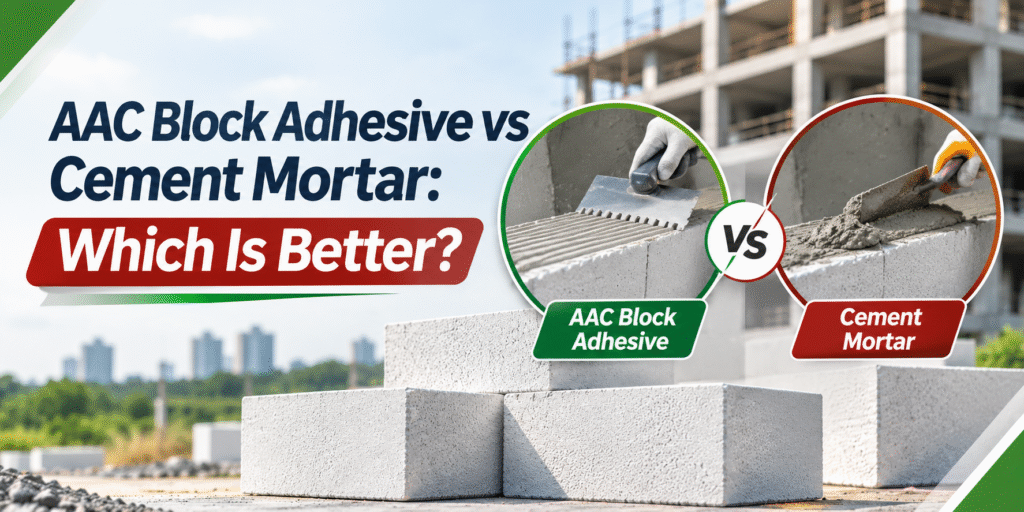
Choosing the right bonding material is just as important as selecting the right building blocks. When constructing walls using Autoclaved Aerated Concrete (AAC) blocks, one important question builders, contractors, and homeowners often ask is: Should you use AAC block adhesive or traditional cement mortar?
Both materials are used for masonry construction, but they differ in composition, application thickness, material consumption, bonding characteristics, labour requirements, and construction efficiency.
Traditional cement mortar has been used in Indian construction for decades. However, with the increasing adoption of lightweight AAC blocks, specially formulated AAC block adhesives have become a popular solution for block jointing.
So, which option is better for AAC block construction in India?
In this guide, we compare AAC block adhesive vs cement mortar, explain their differences, discuss their advantages and limitations, and help you understand which bonding material is suitable for your construction project.
At Real Rock AAC Blocks, we understand that quality construction depends on choosing the right materials and following suitable installation practices. Let’s explore both options in detail.
What Is AAC Block Adhesive?
AAC block adhesive, also known as AAC block jointing mortar or thin-bed mortar, is a specially formulated bonding material designed for joining AAC blocks.
Unlike conventional cement mortar, which is generally prepared by mixing cement, sand, and water at the construction site, AAC block adhesive is typically supplied as a factory-prepared dry powder.
It generally contains:
- Cement as a binding material.
- Graded fine sand or mineral fillers.
- Special polymers and additives.
- Water-retention and workability-enhancing components.
When mixed with the recommended quantity of water, it forms a workable adhesive that helps bond AAC blocks with relatively thin joints.
Key Characteristics of AAC Block Adhesive
- Designed for lightweight AAC masonry.
- Applied in relatively thin layers.
- Provides consistent bonding when correctly mixed and applied.
- Helps maintain uniform block joints.
- Reduces the quantity of jointing material required.
- Supports faster and cleaner masonry work.
Depending on the product formulation, the recommended application thickness is generally around 2–5 mm. Always follow the manufacturer’s technical data sheet.
What Is Traditional Cement Mortar?
Cement mortar is a conventional masonry bonding material prepared by mixing cement, sand, and water.
It has been used extensively in brickwork, concrete block construction, and other masonry applications.
Common cement mortar proportions include 1:4 and 1:6, where the first number represents cement and the second represents sand. The appropriate mix depends on the masonry application and project specifications.
Key Characteristics of Cement Mortar
- Prepared using commonly available materials.
- Can be mixed directly at construction sites.
- Familiar to most traditional masonry workers.
- Suitable for conventional brick masonry.
- Can be used for AAC block masonry where the specified installation method permits it.
- Requires proper proportioning, mixing, application, and curing.
Traditional cement mortar generally creates thicker masonry joints than thin-bed AAC block adhesive.
For AAC block masonry, conventional mortar joints may be around 8–10 mm, depending on the specified system and construction guidance.
AAC Block Adhesive vs Cement Mortar: Key Differences
The biggest difference between AAC block adhesive and cement mortar is their composition and application method.
Here is a comparison of both materials.
| Comparison Factor | AAC Block Adhesive | Traditional Cement Mortar |
|---|---|---|
| Composition | Cement, graded sand, polymers and additives | Cement, sand and water |
| Preparation | Factory-prepared dry mix | Usually mixed at construction site |
| Application thickness | Generally 2–5 mm | Generally 8–10 mm or as specified |
| Material consumption | Lower due to thin joints | Higher due to thicker joints |
| Bonding | Formulated for thin-bed block jointing | Depends on mix proportion and workmanship |
| Dimensional accuracy | Works well with accurately manufactured blocks | Thicker joints can accommodate some variation |
| Labour | Requires suitable application tools and training | Familiar to conventional masonry workers |
| Worksite cleanliness | Generally cleaner application | More mixing and material handling |
| Construction efficiency | Can improve masonry productivity | May require more material and application time |
| Curing | Follow adhesive manufacturer’s instructions | Conventional masonry joints generally require curing |
| Cost | Product price may be higher per bag | Ingredients may be cheaper individually |
The actual performance of either material depends on product quality, block dimensions, site conditions, workmanship, and the manufacturer’s installation recommendations.
1. Application Thickness: Thin Joints vs Thick Joints
One of the most noticeable differences between AAC block adhesive and cement mortar is the thickness of the joint.
AAC Block Adhesive
AAC block adhesive is designed for thin-bed application.
Depending on the manufacturer’s specifications, it is generally applied at approximately 2–5 mm thickness.
Because AAC blocks are manufactured with relatively accurate dimensions, thin adhesive joints help maintain consistent alignment between individual blocks.
Benefits include:
- Reduced jointing material consumption.
- More uniform masonry joints.
- Less variation in wall thickness.
- Reduced thermal bridging through thick mortar joints.
Cement Mortar
Traditional cement mortar is generally applied in thicker joints, commonly around 8–10 mm for AAC masonry where this method is specified.
Thicker joints require more mortar and can introduce greater variation in wall dimensions if application is inconsistent.
Which is better?
For accurately manufactured AAC blocks and a compatible thin-bed masonry system, AAC block adhesive is generally the preferred option for regular horizontal and vertical block joints.
2. Bonding Strength and Wall Stability
Bonding strength is an important consideration when constructing AAC block walls.
AAC Block Adhesive
Specially formulated AAC block adhesive contains binding materials and additives designed to provide suitable adhesion at thin application thicknesses.
When correctly prepared and applied, it creates consistent joints between blocks.
However, the actual bonding performance depends on:
- Product formulation.
- Water-to-powder ratio.
- Surface preparation.
- Application thickness.
- Working time.
- Environmental conditions.
Cement Mortar
Cement mortar also provides bonding between masonry units when prepared and applied correctly.
However, achieving consistent results requires proper control over cement and sand proportions, water quantity, mixing, and curing.
An incorrectly prepared mortar mix may affect bonding and contribute to shrinkage or cracking.
Which is better?
AAC block adhesive offers a purpose-formulated solution for thin-bed AAC masonry. Cement mortar remains a usable alternative where the specified construction system permits it.
Neither material should be selected without considering the project’s technical requirements.
3. Material Consumption and Cost
Cost is one of the biggest factors influencing material selection.
At first glance, traditional cement mortar may appear cheaper because cement and sand are readily available in the market.
However, the total cost should include material consumption, labour, preparation, transportation, and finishing.
Cost of AAC Block Adhesive
AAC block adhesive generally requires less material because it is applied in thinner joints.
Its advantages include:
- Lower jointing material consumption.
- Reduced mixing requirements.
- Less material handling.
- More consistent application.
- Potential savings in masonry labour.
Cost of Cement Mortar
Traditional cement mortar may have a lower initial ingredient cost, but thicker joints require more material.
Additional considerations include:
- Cement consumption.
- Sand procurement.
- Mixing labour.
- Water requirements.
- Material transportation.
- Joint curing.
Which is more economical?
The answer depends on the local prices of adhesive, cement, and sand, along with actual consumption and labour rates.
Do not compare the price of one bag of AAC adhesive with the price of one bag of cement alone.
Instead, calculate the total jointing cost per square metre of completed wall.
4. Construction Speed and Labour Efficiency
Construction speed plays an important role in residential and commercial projects.
Builders often work with strict project schedules, making efficient masonry practices essential.
AAC Block Adhesive
AAC block adhesive can improve construction efficiency because it is supplied as a prepared dry mix.
Workers generally need to add the recommended quantity of water, mix the product, and apply it using an appropriate notched trowel.
Its advantages include:
- Faster preparation.
- Uniform application.
- Less material handling.
- Reduced joint thickness.
- Improved masonry productivity.
Cement Mortar
Traditional cement mortar requires cement and sand to be measured, mixed, and prepared before application.
This process can involve additional labour and material handling.
Which is better?
AAC block adhesive generally offers better application efficiency when workers are trained and the correct tools are available.
However, the actual time savings depend on site organisation, workforce experience, and construction conditions.
5. Thermal Insulation and Energy Efficiency
AAC blocks are known for their thermal insulation properties because of their cellular internal structure.
However, the bonding material used between blocks can also influence the overall thermal performance of a wall.
AAC Block Adhesive
Thin adhesive joints reduce the amount of dense jointing material between AAC blocks.
This helps maintain the continuity of the wall’s thermal insulation characteristics.
Cement Mortar
Conventional cement mortar is generally applied in thicker joints.
Because cement mortar has different thermal properties from AAC, thicker joints may create more thermal bridging through the masonry.
Which is better?
Thin-bed AAC adhesive generally helps minimise thermal bridging through masonry joints compared with conventional thick mortar joints.
The overall thermal performance still depends on wall thickness, block density, workmanship, plaster, insulation, and the complete wall assembly.
6. Worksite Cleanliness and Ease of Application
Construction site management is another important consideration.
AAC Block Adhesive
AAC block adhesive is supplied in dry powder form and mixed with water as required.
It generally offers:
- Easier material storage.
- More controlled mixing.
- Consistent application.
- Less loose sand handling.
- Cleaner work areas.
Cement Mortar
Traditional cement mortar requires cement, sand, water, and appropriate mixing arrangements.
This can increase material movement, storage requirements, and site cleaning activities.
Which is better?
AAC block adhesive generally offers a cleaner and more controlled application process, particularly on larger projects.
AAC Block Adhesive vs Cement Mortar: Which Is Better for Construction in India?
For most conventional AAC block wall applications using dimensionally accurate blocks, specially formulated AAC block adhesive is generally the more efficient choice for the regular masonry joints.
It offers several advantages:
- Thin application thickness.
- Lower jointing material consumption.
- Consistent bonding.
- Reduced thermal bridging.
- Faster application.
- Better control over joint thickness.
However, traditional cement mortar should not be considered unsuitable in every situation.
It may be required for the initial levelling course, where the supporting surface needs correction, or for masonry systems where conventional mortar is specifically recommended.
The Housing and Building Research Institute’s Eco Friendly AAC Block Masonry Manual describes both conventional cement-sand mortar and thin-bed mortar as AAC masonry jointing options. It also describes an initial levelling bed using cement mortar and gives guidance on conventional mortar joint thickness.
You can consult the AAC Block Masonry Manual for further technical information.
The final choice should follow the AAC block manufacturer’s instructions, the adhesive product data sheet, and the project engineer’s specifications.
Can You Use Cement Mortar for AAC Blocks?
Yes. Conventional cement mortar can be used for AAC block masonry in applications where the selected masonry system and project specifications permit it.
However, the mortar must be correctly proportioned, mixed, applied, and cured.
There are also some important considerations:
- Thick mortar joints can increase material consumption.
- Inconsistent joint thickness can affect wall alignment.
- Incorrect mortar proportions may contribute to shrinkage.
- Proper curing and moisture management are important.
- The mortar must be compatible with the block and installation requirements.
For these reasons, many AAC block manufacturers and construction professionals recommend purpose-formulated thin-bed adhesive for regular block joints.
For additional product guidance, refer to Powerlite AAC’s FAQ on AAC block jointing mortar.
How to Apply AAC Block Adhesive Correctly
Even high-quality AAC block adhesive will not perform as expected if it is applied incorrectly.
Follow the adhesive manufacturer’s instructions and use appropriate masonry tools.
Step 1: Prepare the Surface
Clean the supporting surface and remove dust, loose particles, oil, and other contaminants.
Ensure that the base is suitable for masonry installation.
Step 2: Lay the First Course
The first course is particularly important because it establishes the alignment and level of the entire wall.
Where specified, use an appropriate conventional levelling mortar bed to correct unevenness in the supporting surface.
Check the level and alignment before proceeding.
Step 3: Prepare the AAC Block Adhesive
Use a clean mixing container.
Add the quantity of clean water specified by the adhesive manufacturer and gradually add the dry adhesive powder.
Mix until the material reaches a uniform consistency without lumps.
Do not add excessive water.
Step 4: Apply Adhesive
Spread the adhesive uniformly using a suitable notched trowel.
Follow the recommended application thickness specified in the product data sheet.
Avoid preparing more adhesive than can be used within its stated working time.
Step 5: Position the AAC Blocks
Place each block carefully over the adhesive bed.
Maintain proper horizontal and vertical alignment.
Use a rubber mallet and suitable measuring tools to make adjustments without damaging the blocks.
Step 6: Check the Wall Alignment
Regularly inspect the wall using a spirit level and straightedge.
Ensure that the joints are filled properly and that the blocks are positioned according to the approved masonry layout.
For a more detailed walkthrough, read our AAC Block Installation Guide: Step-by-Step Wall Construction Process.
Common Mistakes to Avoid When Using AAC Block Adhesive
Incorrect application can reduce the effectiveness of AAC block adhesive and affect the quality of masonry.
Avoid these common mistakes:
1. Using too much water: Always follow the recommended mixing ratio. Excessive water can affect consistency and performance.
2. Applying thick adhesive layers: AAC block adhesive is designed for thin-bed applications. Maintain the thickness specified by the manufacturer.
3. Ignoring surface preparation: Dust, loose particles, and contaminants can interfere with proper bonding.
4. Using expired material: Check the manufacturing date, expiry information, and storage conditions before use.
5. Reusing hardened adhesive: Do not retemper or reuse material that has exceeded its working time or started setting.
6. Ignoring block alignment: Incorrect alignment in the first course can affect the entire wall.
7. Using unsuitable adhesive: Select a product specifically recommended for the AAC block system being installed.
8. Ignoring site conditions: Temperature, moisture, and exposure conditions can affect application and setting. Follow the product manufacturer’s recommendations.
Why Choose Real Rock AAC Blocks?
Choosing quality AAC blocks is the first step towards achieving efficient and reliable wall construction.
At Real Rock AAC Blocks, we focus on manufacturing and supplying lightweight AAC blocks for residential, commercial, and industrial construction requirements.
Based in Telangana, Real Rock AAC Blocks serves construction requirements across Telangana and Andhra Pradesh.
Our product range is designed to support different wall applications with multiple block thicknesses and published technical specifications.
What Makes Real Rock AAC Blocks a Suitable Choice?
- Multiple AAC block sizes for different wall applications.
- Published technical specifications.
- Lightweight construction solutions.
- Thermal insulation properties.
- Dimensional accuracy.
- Suitable product options for modern construction requirements.
Real Rock also provides product information and construction guidance to help buyers understand the appropriate specifications for their projects.
If you are planning a residential building, apartment complex, commercial project, or industrial facility, explore our Real Rock AAC Blocks website to learn more about our products.
For technical details, visit our AAC Block Technical Specifications page.
Frequently Asked Questions (FAQs)
1. Which is better for AAC blocks: adhesive or cement mortar?
AAC block adhesive is generally preferred for regular AAC block joints because it offers thin application, consistent bonding, lower material consumption, and improved construction efficiency. Cement mortar can also be used where specified, particularly for initial levelling.
2. What is the recommended thickness of AAC block adhesive?
AAC block adhesive is generally applied at approximately 2–5 mm thickness, depending on the product formulation and manufacturer’s instructions.
3. Can normal cement mortar be used for AAC blocks?
Yes. Conventional cement-sand mortar can be used for AAC block masonry when permitted by the manufacturer’s installation guidance and project specifications. However, it generally creates thicker joints than specialised AAC block adhesive.
4. Is AAC block adhesive stronger than cement mortar?
There is no universal answer because the materials have different formulations, application thicknesses, and testing requirements. Specialised AAC adhesive is formulated to provide suitable bonding in thin-bed applications. Performance should be assessed using the relevant technical data and test results.
5. Does AAC block adhesive reduce construction costs?
It can reduce overall masonry costs through lower material consumption, faster application, and improved labour efficiency. Actual savings depend on local material prices, labour rates, block dimensions, and site conditions.
6. Do AAC block adhesive joints require curing?
Curing requirements depend on the adhesive formulation and manufacturer instructions. Do not automatically apply conventional cement mortar curing procedures to every thin-bed adhesive product.
7. Can AAC block adhesive be used for red bricks?
Some block joining mortars are formulated for multiple masonry products, including AAC blocks, concrete blocks, and fly ash bricks. However, suitability for red bricks must be confirmed using the specific product’s technical data sheet.
8. Which adhesive is suitable for Real Rock AAC Blocks?
Choose a purpose-formulated AAC block jointing adhesive that is compatible with the block dimensions and installation system. Follow the adhesive manufacturer’s recommendations and the project engineer’s instructions.
Final Verdict: AAC Block Adhesive or Cement Mortar?
When comparing AAC block adhesive vs cement mortar, the right choice depends on the construction method, product specifications, and site requirements.
For regular joints in accurately manufactured AAC block masonry, thin-bed AAC block adhesive is generally the preferred solution because it offers consistent bonding, lower material consumption, and efficient application.
Traditional cement mortar still has an important role, particularly in initial levelling and applications where conventional mortar is specified.
For the best construction results, choose quality AAC blocks, use compatible jointing materials, and follow the recommended installation procedure.
At Real Rock AAC Blocks, we believe that smarter construction starts with the right building materials and the right installation practices.
Visit https://realrockaac.com/ to explore our AAC block solutions and find the right products for your next construction project.